Research
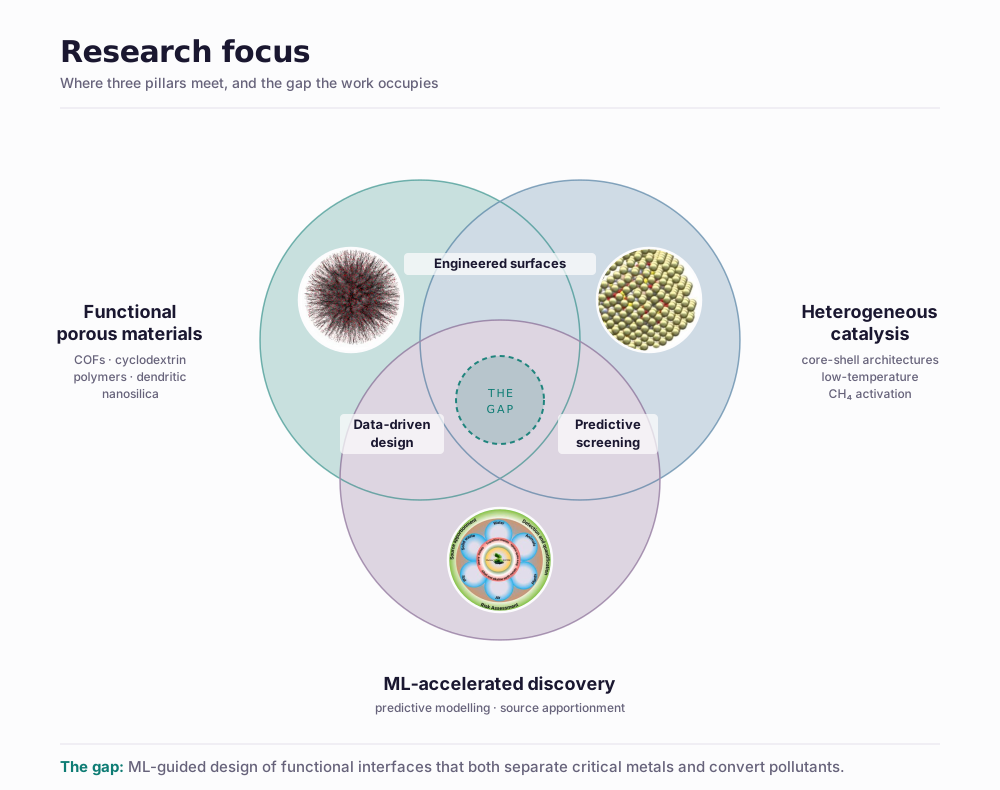
A programme built over twelve years across the CAS Institute of Urban Environment, Harbin Institute of Technology (Shenzhen), and Guangzhou University, spanning three connected pillars: the materials themselves, the catalytic chemistry they enable, and the machine learning that increasingly guides both.
Functional porous materials
Design and synthesis of covalent organic frameworks, β-cyclodextrin polymers, magnetic composites and dendritic fibrous nanosilica (DFNS), each engineered so that pore chemistry does the separation work. The current focus is a green, closed-loop route — leaching, selective adsorption, recovery — that treats industrial sludge and wastewater as an ore body rather than a disposal problem.
- Extractant-immobilized dendritic fibrous nanosilica for rapid and selective rare-earth separation from complex aqueous matrices Desalination 2026 D-DEHPA on dendritic nanosilica: ~5 min equilibrium, 153.8 mg/g, and a Dy/La separation factor of 17.3 held up in real industrial leachate.
- Ultrafast and selective recovery of rare earths from aqueous streams using a P507-scaffolded dendritic nanosilica Journal of Cleaner Production 2026 86.2 mg/g dysprosium capacity with >95% removal inside five minutes, and ~94% retained over five regeneration cycles.
- Selective and fast recovery of rare earth elements from industrial wastewater by porous β-cyclodextrin and magnetic β-cyclodextrin polymers Water Research 2020 Porous and magnetic β-cyclodextrin polymers that sequester Nd, Gd, Eu and Y selectively, and regenerate over five cycles.
- A closed-loop system to recycle rare earth elements from industrial sludge using green leaching agents and porous β-cyclodextrin polymer composite Resources, Conservation and Recycling 2022 A closed-loop route recovering 76–87% of the rare earths from industrial sludge using green leaching agents.
Heterogeneous catalysis
Core-shell architectures for pollutant conversion, concentrating on the conditions that break real catalysts: wet, sulfur-laden exhaust at temperatures low enough to be practical. Work spans selective catalytic reduction of NOx by methane and the broader problem of activating the C–H bond at low temperature.
- Core-shell In/H-Beta@Ce catalyst with enhanced sulfur and water tolerance for selective catalytic reduction of NOx by CH4 Journal of Hazardous Materials 2025 97.5% NOx conversion at 600 °C; the amorphous ceria shell shields the In/O active sites and limits sulfate formation.
- Current Progress on Methods and Technologies for Catalytic Methane Activation at Low Temperatures Advanced Science 2023 Catalytic methane activation from 50–500 °C across thermo-, photo- and electrocatalysis and non-thermal plasma.
ML-accelerated discovery
The newest of the three pillars: using machine learning to model how materials and contaminants interact, to apportion pollution sources, and to narrow the experimental search space before anything reaches the bench.
- Machine learning approaches for monitoring environmental metal pollutants: Recent advances in source apportionment, detection, quantification, and risk assessment TrAC Trends in Analytical Chemistry 2024 A survey of machine learning for source apportionment, detection, quantification and risk assessment of metal pollutants.
Methods and capabilities
- Synthesis
- COFs, β-CD polymers, magnetic composites, dendritic fibrous nanosilica, core-shell catalysts, ionic-liquid-grafted mesoporous materials.
- Characterisation
- XRD, BET, FT-IR, XPS, SEM-EDX, TEM, ICP-MS, TGA, zeta potential.
- Process engineering
- Flow reactor systems, adsorption columns, leaching–separation–recovery workflows; techno-economic modelling with sensitivity analysis.
- Collaboration
- Joint projects across more than ten institutions in China, Africa and the United States; co-supervision of MSc candidates.